
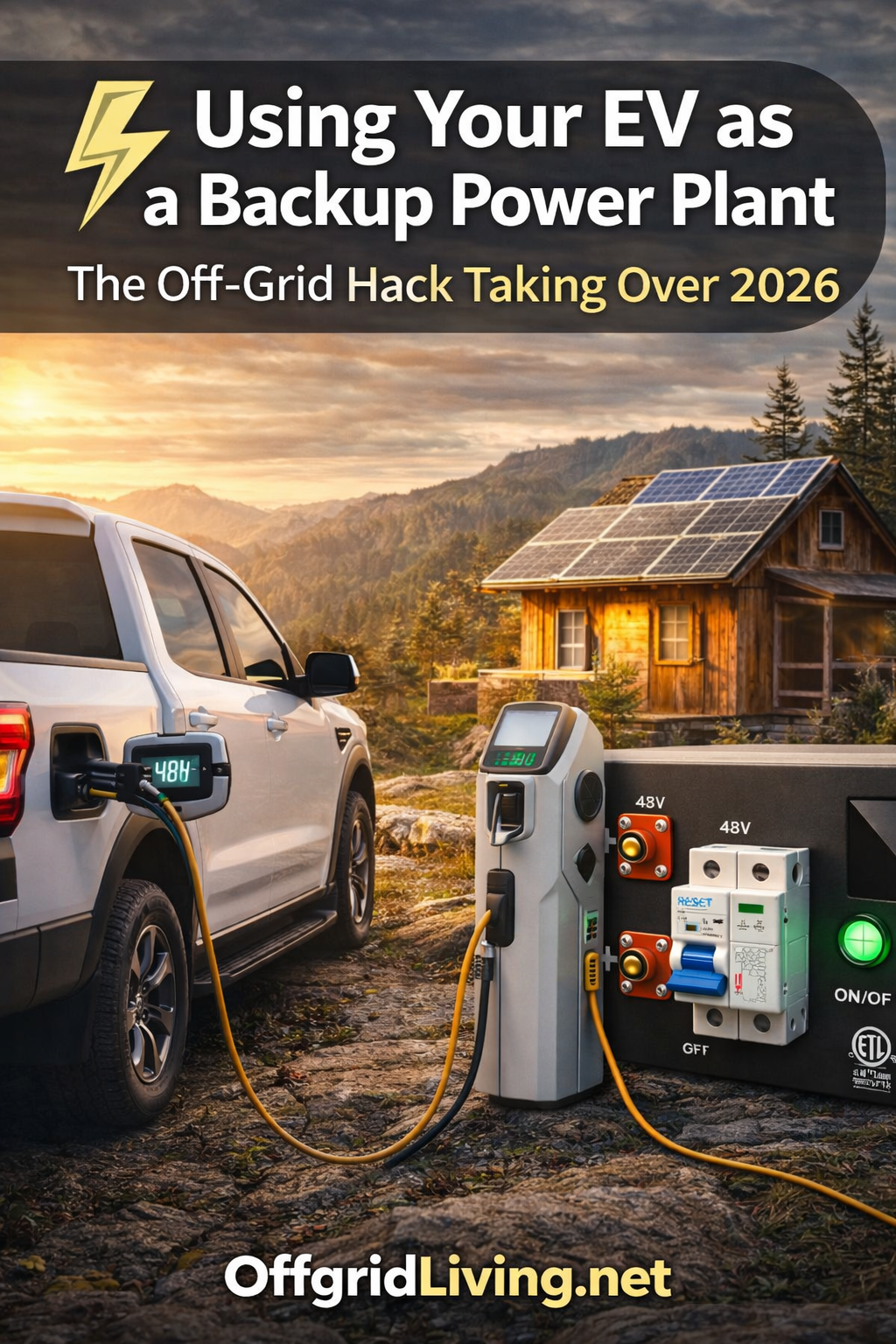
In 2026, your vehicle might be the most powerful battery on your property.
Not your solar bank.
Not your generator.
Your electric vehicle.
As EV battery capacities climb past 70, 100, even 200 kWh, off-grid builders and energy-conscious homeowners are discovering something revolutionary:
Your EV isn’t just transportation anymore.
It’s a mobile power plant.
Looking for electric buggy cars? The NAVEO-X Series offers a reliable solution for internal transport across resorts, industrial estates, and large facilities.
Welcome to one of the biggest off-grid shifts of 2026 — Vehicle-to-Home (V2H) and Vehicle-to-Load (V2L) systems.
🚘 Why This Is Exploding Right Now
Modern EVs like the ones from Victron Energy now store more energy than most residential battery systems.
Let’s compare:
-
Typical DIY off-grid battery bank: 10–20 kWh
-
Mid-size EV battery: 60–100 kWh
-
Electric trucks & large SUVs: 120–200+ kWh
That means your vehicle could power:
-
A small off-grid cabin for days
-
An energy-efficient home for 24–72 hours
-
Critical appliances for a week or more
And unlike a generator, it’s silent.
No fumes.
No fuel storage.
No oil changes.
Just stored electricity.
🔋 How Much Power Are We Talking About?
Here’s a practical example:
If your home consumes:
-
1.5 kWh per hour (moderate usage)
-
36 kWh per day
And your EV has a 75 kWh battery:
You could theoretically power your home for two full days — without solar input.
If you pair that with daytime solar production?
You extend that window significantly.
For off-grid or backup applications, that’s game-changing.
⚡ The Three Ways EVs Can Power Your Property
1️⃣ Vehicle-to-Load (V2L)
Some EVs now include built-in 120V or 240V outlets.
You can plug in:
-
Refrigerators
-
Power tools
-
Freezers
-
Medical equipment
-
Small cabin loads
This is the simplest method — no home integration required.
Think of it as a giant portable power station on wheels.
2️⃣ Vehicle-to-Home (V2H)
This is where things get serious.
With a bidirectional charger and proper inverter setup, your EV can:
-
Feed power directly into your home’s electrical panel
-
Automatically activate during outages
-
Integrate with solar systems
In this setup, your EV becomes a true backup battery bank.
It behaves similarly to a Tesla Powerwall — just much larger.
3️⃣ Vehicle-to-Grid (V2G)
This is more advanced and still expanding in 2026.
It allows:
-
Selling energy back to the grid
-
Peak shaving during high-rate hours
-
Grid stabilization participation
While more common in grid-connected environments, it signals a larger trend:
Energy is becoming decentralized.
🏕 Why Off-Grid Owners Are Paying Attention
For serious off-grid setups, redundancy is everything.
Historically, backup meant:
-
Diesel generator
-
Extra battery bank
-
Fuel storage
Now?
Your EV can replace or drastically reduce generator use.
Imagine this:
Storm rolls in.
Cloud cover lasts three days.
Solar production drops.
Instead of firing up a loud generator, you plug in your EV.
Silent resilience.
🔌 What You Actually Need to Make This Work
This isn’t plug-and-play for every EV yet.
Here’s what determines feasibility:
✅ 1. EV Compatibility
Not all electric vehicles support bidirectional charging.
You need:
-
V2L capability (simplest option)
-
Or full V2H compatibility
Some newer models in 2026 now ship ready for this.
✅ 2. Bidirectional Charger
This is critical for V2H.
Unlike standard chargers (which only push energy into the car), bidirectional chargers:
-
Pull energy from the car
-
Convert DC to usable AC
-
Sync safely with your home system
This is where professional installation often becomes necessary.
✅ 3. Transfer Switch / Home Integration
To safely power your home:
-
You need isolation from the grid
-
Proper load management
-
Electrical code compliance
For off-grid properties, integration is simpler because the system is already isolated.
💰 Is It Cheaper Than Installing More Batteries?
This is the million-dollar question.
Let’s compare.
If you already own an EV:
The battery capacity is already paid for.
Adding V2H capability might cost:
-
$3,000–$7,000 depending on setup
Now compare that to installing:
-
60 kWh of LiFePO4 batteries
-
Inverters
-
Wiring
-
Enclosures
That could easily cost $15,000–$30,000+.
So if you own the EV anyway, the economics start making serious sense.
⚠ What About Battery Degradation?
One common concern:
“Will using my EV as backup power wear out the battery faster?”
The honest answer:
Yes — slightly. But not dramatically.
EV batteries are engineered for:
-
Thousands of deep cycles
-
Heavy load demands
-
Advanced battery management systems
Using 20–40% of capacity during occasional outages will not destroy your pack.
And in many cases, the convenience outweighs the minimal long-term degradation.
🌄 Perfect Use Cases for Off-Grid Living
This setup makes the most sense for:
-
Hybrid off-grid properties
-
Solar-powered cabins
-
Homesteads with long winter cloud cover
-
Preppers wanting silent redundancy
-
Remote workshops
-
RV and vanlife conversions
Imagine pulling up to your remote cabin with a fully charged EV.
You arrive with 70+ kWh of stored power.
That’s freedom.
🔥 Real-World Scenario
Let’s build a simple example:
You have:
-
12 kW solar array
-
20 kWh LiFePO4 home battery
-
80 kWh electric truck
Winter storm hits.
Solar output drops to 25% for three days.
Instead of rationing power, you:
-
Draw 30 kWh from your truck
-
Maintain full refrigeration
-
Keep lights and internet running
-
Avoid burning fuel
No noise.
No fumes.
No stress.
That’s modern resilience.
🚀 Where This Is Heading
By 2026, automakers are clearly moving toward:
-
Standardized bidirectional charging
-
Smarter home integration
-
App-based energy management
-
Grid participation incentives
The lines between:
Car
Battery bank
Generator
Home
Are disappearing.
Your vehicle is no longer just transportation.
It’s infrastructure.
🧠 Should You Design Your Off-Grid System Around Your EV?
If you already own an EV — absolutely consider it.
If you’re planning an off-grid build:
It may be worth factoring in future compatibility.
We’re entering a phase where:
The most expensive battery you’ll ever buy
is already sitting in your driveway.
Final Thoughts
The off-grid world has always been about independence.
Solar panels gave us generation.
Lithium gave us storage.
Now EVs give us mobility + massive backup capacity in one system.
Using your EV as a backup power plant isn’t a fringe hack anymore.
In 2026, it’s becoming standard strategy.
Energy is no longer centralized.
It’s personal.
Portable.
And increasingly intelligent.
And if you’re paying attention, you’ll design your system accordingly.